On 12 November 1948 in Tokyo the reading of a verdict that had lasted more than a week came to an end. The International Military Tribunal found 25 former Japanese leaders guilty. But there was no unanimity among the judges: one of them wrote a dissenting opinion running to more than 1,200 pages and proposed acquitting all the accused, although he did not deny the crimes committed by Japanese troops.
Historians and lawyers still debate the trial: how the court was formed, what the prosecution was built on, and why not all the judges agreed with the verdict. And many of the legal decisions the tribunal took in 1946–1948 remain part of international law.
This is “Lex ab initio: the law we live by” – TRP International’s series on where the rules applied today by courts and arbitral tribunals come from. Ab initio is Latin for “from the beginning”: we move from the first laws to the decisions in force now. Each instalment offers one story from the law of the past and a takeaway for modern practice.
In this article:
- who sat in judgment, and why the defence demanded the recusal of the presiding judge;
- whether one can be tried for a crime that was not in the law at the time of the events;
- why a general was convicted although he never ordered the crimes;
- how the judges divided, and why their separate opinions are still read today.
The court a general established
Japan signed the instrument of surrender on 2 September 1945. A few months later, on 19 January 1946, the Supreme Commander for the Allied Powers in Japan, General Douglas MacArthur, approved the charter of the International Military Tribunal for the Far East. The model was the charter of the Nuremberg Tribunal, which by then was already sitting in Germany.
Judges were appointed by eleven states: the United States, the United Kingdom, the USSR, China, France, the Netherlands, Australia, Canada, New Zealand, India and the Philippines. The Australian judge William Webb became president. The USSR sent Major-General of Justice Ivan Zaryanov. The working languages were English and Japanese. Zaryanov spoke neither, and he was allowed to work with an interpreter.
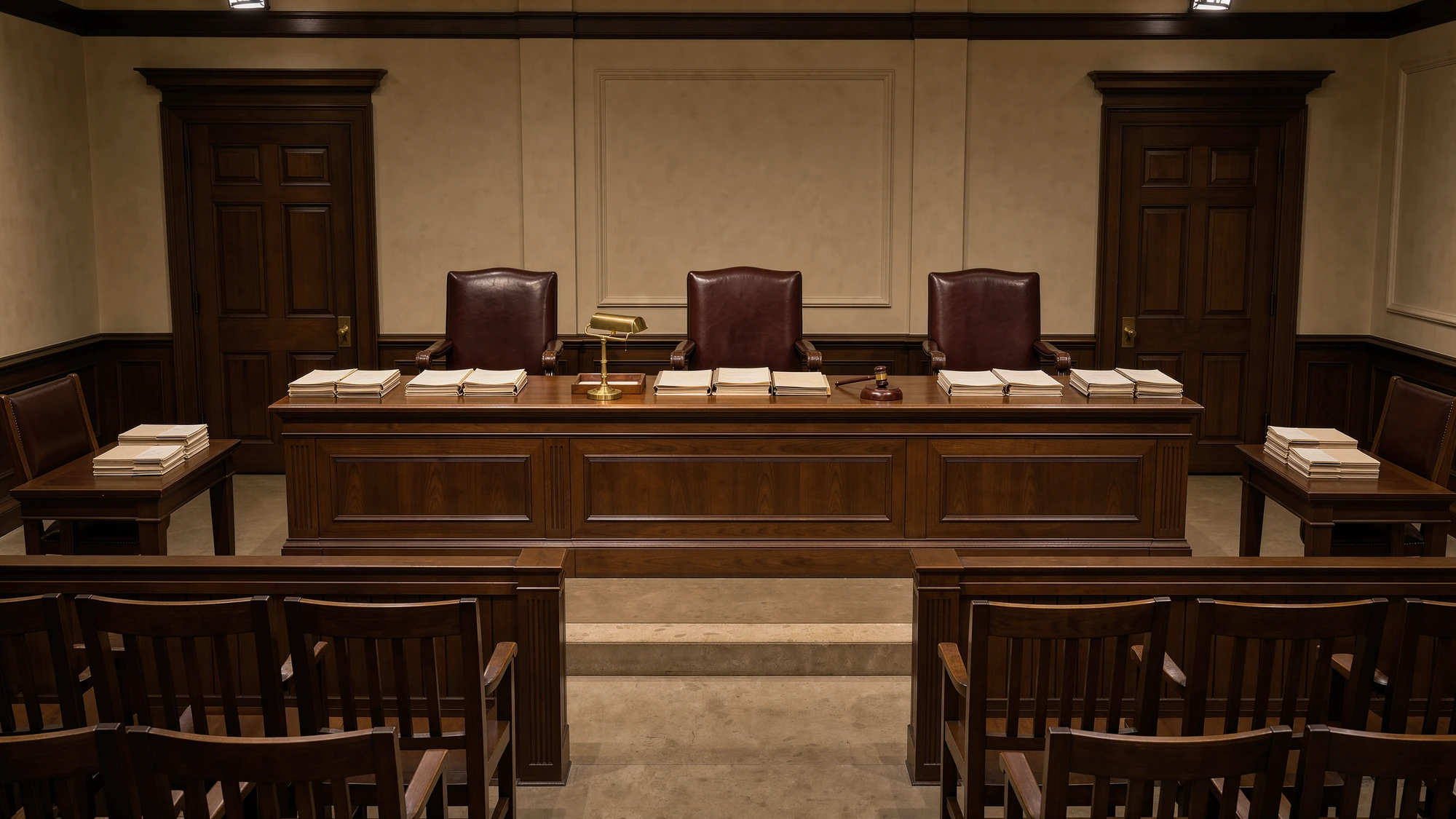
The indictment was brought against 28 former Japanese leaders – prime ministers, ministers, generals and diplomats. The trial opened on 3 May 1946 in the former building of the War Ministry in the Ichigaya district of Tokyo. Emperor Hirohito was not brought to trial – that was the decision of the occupation authorities.
Recusal of the presiding judge
Can a judge hear a case about events he himself investigated earlier?
The defence raised this question in the first days of the trial. On 6 May 1946 it sought the recusal of the tribunal’s president: before his appointment Webb had led the Australian investigation into war crimes committed by Japanese troops in New Guinea. In the defence’s view, this deprived him of impartiality.
The tribunal rejected the challenge and Webb remained president. Objections by the defence to the jurisdiction of the tribunal as a whole were rejected later as well. But the question of impartiality has not gone away – researchers of the trial keep returning to it.
Can you be tried after the fact?
The central charge was crimes against peace, that is, planning and waging aggressive war. The charge covered the period from 1928 to 1945. Unlike Nuremberg, in Tokyo this charge was mandatory: only those against whom it was brought were tried.
The defence insisted that in those years international law knew no such crime, and therefore no punishment could follow. This is the principle “no crime without law”, in Latin nullum crimen sine lege.
The tribunal, like Nuremberg before it, answered that aggressive war had been unlawful earlier as well. In 1928 states, including Japan, signed the Kellogg–Briand Pact and renounced war as an instrument of national policy. That answer is still debated by legal historians.
The indictment contained 55 counts. The tribunal found most of them duplicative of one another or beyond the charter, and dealt on the merits with only ten.
Liability for inaction
One of the most discussed counts concerned not orders but their absence. Several defendants were charged with disregarding their duty to take adequate steps to prevent violations of the laws of war.
It was on this count, and only on it, that General Iwane Matsui was convicted. He commanded Japanese forces in the Nanking area. According to the figures cited in the tribunal’s judgment, in the first six weeks of the Japanese occupation more than 200,000 civilians and prisoners of war were killed in the city and its surroundings. The tribunal did not find that Matsui ordered these crimes. But, the court concluded, he knew of them and did nothing, or almost nothing, to stop them.
That ruling became one of the foundations of a principle that is still in force today: a commander is responsible not only for what he ordered but also for what he knew of and failed to prevent although he could have. In modern law it is called the responsibility of commanders and other superiors.
The charter also expressly excluded another defence: neither official position nor an order of a government or a superior by itself relieved a person of responsibility. They could be taken into account only in sentencing.
Eight against three
The tribunal began reading its judgment on 4 November 1948. Two defendants had died during the trial and one more had been found unfit to stand trial. Of the 25 who remained, all were found guilty: seven were sentenced to death, sixteen to life imprisonment, and two former foreign ministers – Shigenori Togo and Mamoru Shigemitsu – to 20 and 7 years.
Eight of the eleven judges supported the judgment. Five, including the president, wrote separate opinions. The best known is the dissent of the Indian judge Radhabinod Pal. He held that crimes against peace had not been established by international law and proposed acquitting all the accused on all counts. Pal did not deny that Japanese troops had committed mass atrocities, but he considered the guilt of the individual defendants in them unproven.
The judges from the Netherlands and France also disagreed with the majority – in part or on procedural points. Several judges noted the absence of the emperor from the dock in their opinions.
The defence could not challenge the verdict in an American court. In December 1948 the US Supreme Court declined to hear the petitions: the tribunal acted on behalf of the Allied powers and was not a court of the United States. The death sentences were carried out on 23 December 1948.
By 1958 all the convicted who remained in custody had been released on parole. Shigemitsu later again became Japan’s foreign minister.
Why the trial is still debated
The Tokyo trial lasted two and a half years: 818 sessions, 419 witnesses, more than 4,300 exhibits and almost 50,000 pages of transcript. By volume of material it is one of the largest trials of the twentieth century, and its documents are still studied by historians and lawyers.
Researchers debate the same questions that the defence raised in 1946: the composition of the court, the basis of the charges and the choice of defendants. Others stress that the trial established and documented many facts of the war, and that thanks to it the principle of individual responsibility for war crimes became a rule of international law.
What it means today
The charter of the tribunal lost force long ago, but many of the questions decided in Tokyo remain live:
- position and orders do not release from responsibility – the charters of the Nuremberg and Tokyo tribunals were among the first to fix this principle;
- inaction can be a violation – a commander who knew of his subordinates’ crimes and took no steps bears responsibility too;
- law does not work retroactively – today this principle is enshrined in the International Covenant on Civil and Political Rights and in the Constitution of Russia;
- the impartiality of a judge is a question of confidence in the ruling – doubts about it stay with the ruling for a long time, even if the challenge was rejected;
- a dissent matters – it can be recalled and cited decades later.
Looking at the trial through the eyes of today’s reader:
- For business – on an entirely different scale, but a similar logic exists in corporate law: a director is responsible not only for his own decisions but also for how control is organised in the company.
- For lawyers – challenge of a judge, objections to jurisdiction and separate opinions are tools that can still shape an international dispute today. In arbitration the question of an arbitrator’s independence is usually resolved before the proceedings begin.
- For anyone interested in history – the Tokyo trial shows how international law tried to answer questions for which it had no ready rules.
On what an arbitrator must disclose about himself to the parties so that his impartiality is beyond doubt – in TRP International’s explainer “The arbitrator is chosen. What must he tell the parties about himself”.
In the next instalment, on 20 November – the Nuremberg trial and Robert Jackson. On that day in 1945 the first international military tribunal opened. We will tell how a justice of the US Supreme Court became his country’s chief prosecutor and why his opening speech is still quoted.
Subscribe to the TRP International channel on Zen so as not to miss the next instalment. Short versions and news about international disputes – on Telegram.
Sources
- University of Virginia School of Law – digital archive of the International Military Tribunal for the Far East
- Peace Palace Library – Tokyo Trial, research guide
- The National WWII Museum – The Tokyo War Crimes Trial
- Hirota v. MacArthur, 338 U.S. 197 (1948)
- J.W. Dower, “Embracing Defeat: Japan in the Wake of World War II” (1999), chapter 15