On 20 November 1945 the first international trial of major war criminals in history opened in Nuremberg. Four powers tried the leaders of Nazi Germany under rules written in advance – with a prosecution, a defence and evidence. The next day the US prosecutor Robert Jackson delivered an address that is still quoted today. The four great powers, he said, “stay the hand of vengeance and voluntarily submit their captive enemies to the judgment of the law”.
Ten months later the tribunal delivered its verdict. The principles on which it was built entered international law and remain in force today.
This is “Lex ab initio: the law we live by”, TRP International’s series on how the rules applied by courts and arbitral tribunals today came into being. Ab initio is Latin for “from the beginning”: we move from the first laws to the decisions in force now. Each issue tells one story from the law’s past and draws a lesson for modern practice.
The Court of Four Powers
On 8 August 1945 the USSR, the United States, Britain and France signed the London Agreement on the prosecution of the major war criminals of the European Axis. Annexed to it was the Charter of the International Military Tribunal – a document that set out the composition of the court, the list of crimes and the rights of the defendants.
Each power appointed a judge and an alternate to the tribunal. The British judge Geoffrey Lawrence became president; the USSR was represented by Ion Nikitchenko. The prosecution was likewise represented by four countries: Roman Rudenko was chief prosecutor for the USSR and Robert Jackson for the United States.
The Charter described the procedure in detail. A defendant received the indictment and all documents in advance and in a language he understood. He could defend himself or use counsel, present evidence and cross-examine prosecution witnesses (Article 16). The tribunal itself was not bound by formal rules of evidence and admitted any evidence it considered to have probative value (Article 19). The tribunal held its first session on 18 October 1945 in Berlin, and the main hearings took place in the Palace of Justice in Nuremberg.
The indictment, dated 6 October 1945, contained four counts: a common plan or conspiracy, crimes against peace, war crimes and crimes against humanity. The charges were brought against 24 leaders of Nazi Germany and six organisations.
The Judge Who Became Prosecutor
How did a sitting judge of a country’s highest court end up in the prosecutor’s seat?
On 2 May 1945 President Harry Truman appointed Robert Jackson chief prosecutor for the United States. Jackson was a Supreme Court justice and took leave from the court to serve at the trial. He also took part in drafting the tribunal’s charter.
Jackson delivered his opening address on 21 November 1945, on the second day of the trial. In it he explained why the court had to be fair to the defendants:
…the record on which we judge these defendants today is the record on which history will judge us tomorrow. To pass these defendants a poisoned chalice is to put it to our own lips as well.
Opening statement of Robert H. Jackson, Chief of Counsel for the United States, 21 November 1945
In the same address Jackson promised the court: “We will not ask you to convict these men on the testimony of their foes.” The prosecution relied above all on thousands of German documents captured by the Allies.
The chief prosecutors of the other powers also delivered opening statements. Roman Rudenko spoke for the USSR on 8 February 1946. The Soviet prosecution presented evidence of the preparation and launching of aggressive wars, including the attack on the Soviet Union in 1941.
A Trial in Four Languages
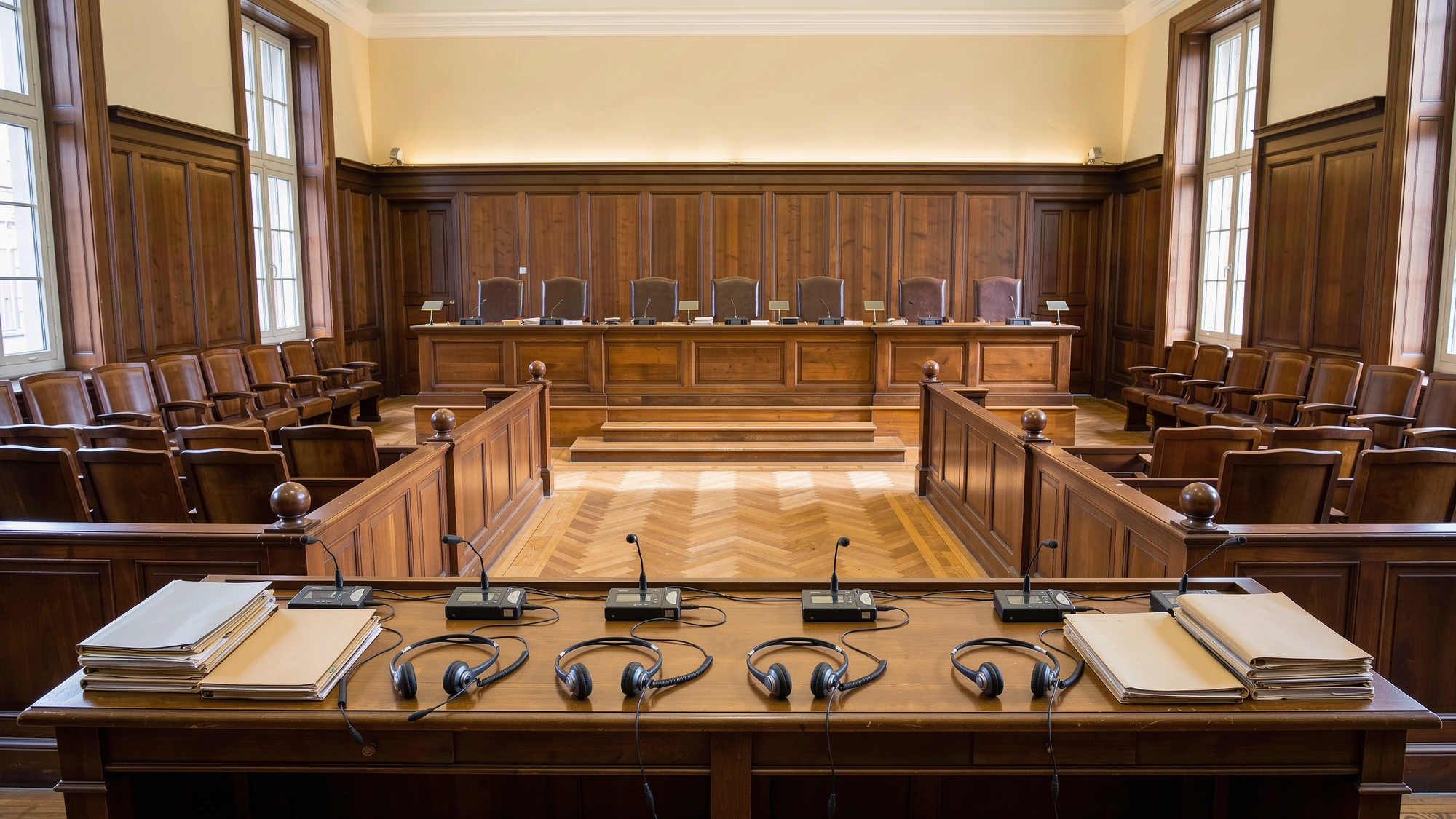
The judges, prosecutors, defendants and counsel spoke Russian, English, French and German. Consecutive interpretation of every remark into three languages would have greatly prolonged the trial. Nuremberg therefore used simultaneous interpretation on such a scale for the first time: the equipment arrived three weeks before the start, and everyone in the courtroom could choose a language on their headphones.
Of 700 candidates for simultaneous interpreters, about five per cent passed the selection. Three teams of twelve worked in the court, relieving one another.
The defendants were given counsel of their choice and translations of the documents. In all, as the judgment records, 403 open sessions were held, and the published record of the trial ran to 42 volumes.
The Verdict and the Dissent
On 31 August 1946 the defendants made their final statements. The tribunal read its judgment over two days – 30 September and 1 October 1946. In effect 21 defendants stood before the court; one more was tried in absentia.
Twelve were sentenced to death, three to life imprisonment and four to terms of 10 to 20 years. Three – Hjalmar Schacht, Franz von Papen and Hans Fritzsche – were acquitted. The SS together with the SD, the Gestapo and the leadership corps of the Nazi Party were declared criminal organisations.
The Soviet judge Ion Nikitchenko issued a dissenting opinion. He disagreed with the acquittal of the three defendants, with life imprisonment instead of death for Rudolf Hess, and with the refusal to declare the government, the general staff and the high command of Germany criminal. The dissent became part of the trial record.
The death sentences were carried out on 16 October 1946.
What Remained in the Law
On 11 December 1946 the UN General Assembly unanimously affirmed the principles of international law recognised by the charter and judgment of the Nuremberg Tribunal. In 1950 the UN International Law Commission formulated them as seven principles. Among them:
- a person, not only a state, is responsible for a crime under international law;
- official position does not relieve of responsibility;
- an order of a government or a superior does not relieve of responsibility if a moral choice was possible;
- every defendant is entitled to a fair trial.
The judgment also established and documented the crimes of Nazism. In Russia denying these facts is prohibited by law.
What It Means Today
The Nuremberg trial ended eighty years ago, but its approaches work in any serious proceeding:
- rules are written before the trial – the charter defined both the crimes and the procedure before the court convened;
- everyone has the right to a defence – even the Nuremberg defendants had counsel of their choice and translated documents;
- a decision must stand the test of time – which is why the record, the evidence and the reasons matter;
- a judge’s dissent is recorded openly – a dissenting opinion shows the position of a judge who remained in the minority.
Through the eyes of today’s reader:
- For business – on a completely different scale, but the same lesson works in commercial disputes: the outcome depends largely on documents. The Nuremberg prosecution rested above all on them.
- For lawyers – procedure determines trust in the result. A dispute heard under rules known in advance is harder to challenge.
- For anyone interested in history – at Nuremberg the gravest crimes were tried by a court, and tried under rules set in advance.
For how proceedings are structured in modern international arbitration and what the parties agree before it begins, see TRP International’s materials on the site.
Which Nuremberg principle do you think matters most today? Write in the comments.
In the next issue, on 28 November – the Laws of the Twelve Tables. We will look at how the oldest code of Roman law emerged and what of it has survived to this day.
Sources
- Avalon Project, Yale Law School – records of the Nuremberg trial, opening statement of R. Jackson
- Avalon Project – judgment of the International Military Tribunal
- Avalon Project – Charter of the International Military Tribunal
- UN – resolution 95 (I) and the Nuremberg Principles
- Avalon Project – transcript of 8 February 1946, opening statement of R. Rudenko
- Avalon Project – dissenting opinion of the Soviet member of the tribunal
- Harvard Law School Library – Nuremberg Trials Project
- The National WWII Museum – Translating and Interpreting the Nuremberg Trials
- Robert H. Jackson Center
- T. Taylor, “The Anatomy of the Nuremberg Trials” (1992)