Everyone knows the phrase “an eye for an eye”, and it is most often linked to the laws of the Babylonian king Hammurabi. The principle is indeed there, but it did not work the way people tend to think: mirror punishment applied only to harm done to someone of equal standing. For the eye of a person of lower status, the price was paid in silver.
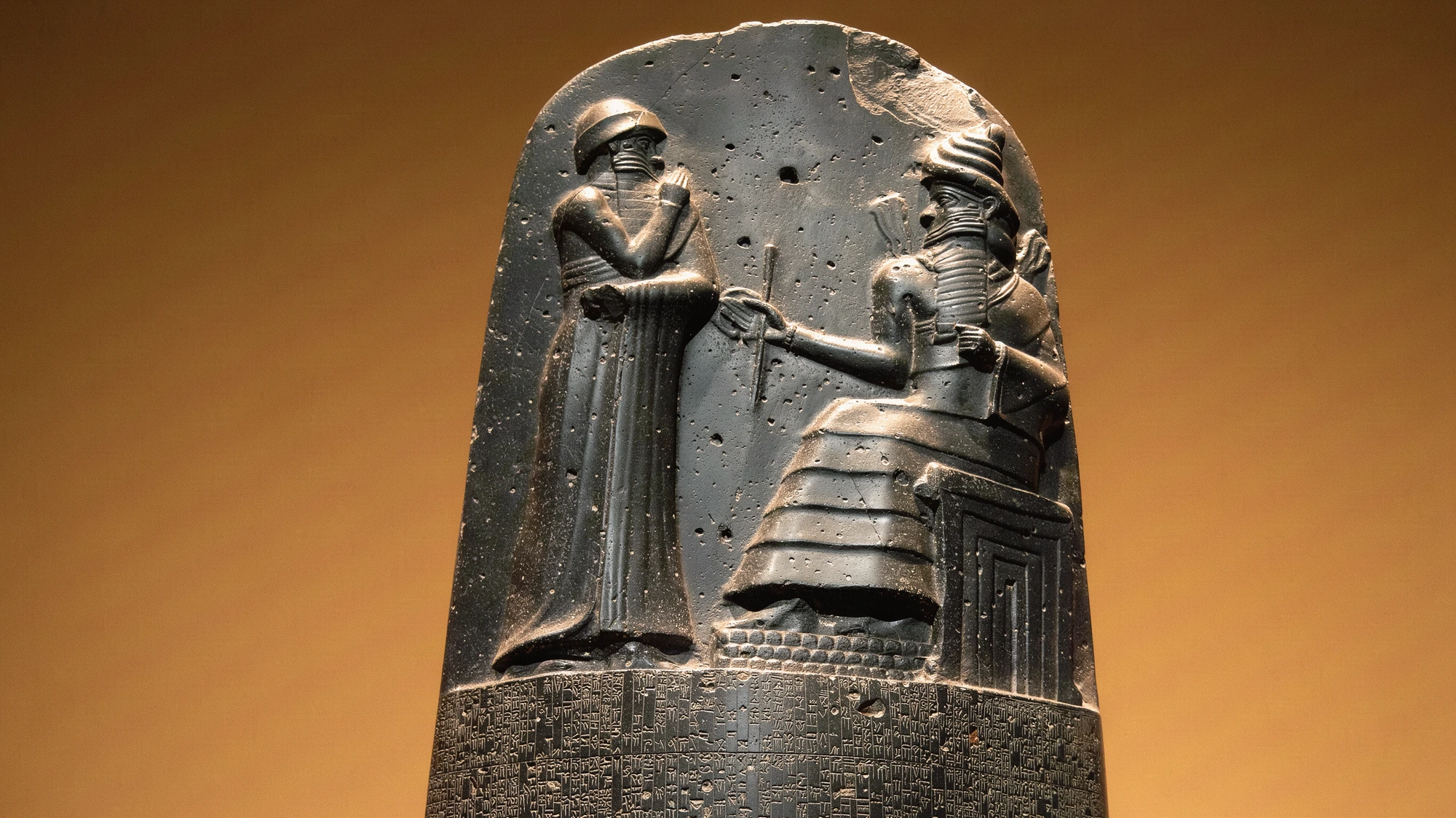
There is far more to be surprised by in a text almost 3,800 years old. A judge who changed a judgment already given paid twelve times the amount in dispute and lost the right to judge for good, while a builder answered with his life for a house that collapsed. The text itself can be seen at the Louvre: it is carved in cuneiform on a black stone stele taller than a person.
This is “Lex ab initio: the law we live by”, the TRP International series on where the rules applied by courts and arbitral tribunals today came from. Ab initio is Latin for “from the very beginning”: we move from the first laws to the decisions in force now. Each issue tells one story from the legal past and draws a conclusion for modern practice.
A trophy that outlived an empire
Hammurabi ruled Babylon from about 1792 to 1750 BC. In that time a small city-state became the centre of a major Mesopotamian power. The collection of laws was compiled in the last years of his reign.
The text was carved on a basalt stele 2.25 metres high. At the top is a relief: the king before Shamash, the god of the sun and justice. The scene makes the point that the king lays down the laws with the blessing of the god of justice.
About six centuries later the stele was carried off as a war trophy to Susa, the capital of neighbouring Elam, in what is now Iran. Some of the columns of laws were chiselled away at that time, probably to make room for the conqueror’s inscription. In 1901–1902 the stele was found by a French archaeological expedition led by Jacques de Morgan, and as early as 1902 the cuneiform scholar Jean-Vincent Scheil published a translation. The lost articles were later partly restored from copies on clay tablets.
A text copied for a thousand years
The laws are written in Akkadian, in cuneiform. The Louvre stele is not their only record: more than 50 manuscripts of the laws from various Mesopotamian cities are known today. The reason is that the code became part of the training of scribes, who learned from it the way schoolchildren learn from a reader. It was copied and memorised for more than a thousand years, and a copy was even listed in the catalogue of the library of the Assyrian king Ashurbanipal, assembled a millennium after Hammurabi.
Not the first, but the most famous
The Code of Hammurabi is often called the first collection of laws, but it is not. The laws of the Sumerian king Ur-Nammu are several centuries older, and the laws of Lipit-Ishtar and Eshnunna are also known. The fame of Hammurabi’s code rests on its completeness and state of preservation: no other legal monument of Mesopotamia has come down to us on such a scale.
The structure of the text is familiar to anyone who has opened a modern statute with a preamble. In the prologue Hammurabi explains that the gods set him to rule so that the strong should not oppress the weak, and lists his achievements. Then come the articles, and at the end an epilogue with a long list of curses on anyone who dares to change or erase what is written.
The articles are grouped by subject, almost like the parts of a modern code, from justice and trade to family and wages. Each describes a specific case on the pattern “if a man has done such and such, then...”. The text contains no general principles: they have to be derived from particular situations.
Courts: prove it or answer for it
The code opens with rules on justice. Anyone who accused another of a serious crime and could not prove it bore the punishment himself. Separate liability awaited those who gave false testimony in court.
The main rule on judges is article 5. If a judge gave a judgment, sealed it and then changed it, he paid twelve times the amount in dispute. He was publicly removed from the judge’s seat and could never judge again. In this way the law protected the finality of decisions: the parties had to be sure that a judgment would not be rewritten after the fact. Older translations sometimes render this rule as a judge’s liability for error.
Trade: money loves a receipt
For transactions in valuables the code required proof. Anyone who, without witnesses and a contract, bought or took for safekeeping silver, gold, slaves or cattle from another man’s son or slave, that is, from someone with no right to dispose of the property, was deemed a thief and put to death. Valuables were to be deposited only before witnesses and under a contract. In essence this is an early version of the rule that a transaction must be capable of proof.
The code also regulated commercial agency. A merchant handed silver to an agent for trading, and the agent kept accounts under receipt and had to report on the results. If he was attacked on the road and robbed of the goods, he could free himself from liability by swearing an oath. Separate rules covered loans, the safekeeping of other people’s property and even the work of tavern keepers.
Debt bondage was limited in time. If a debtor gave up his wife or children for a debt, they worked in the creditor’s house for three years and went free in the fourth. The code also fixed the price of labour: what craftsmen earned and what it cost to hire a boat or working cattle.
Family and inheritance
Almost seventy articles deal with marriage, family and property: divorce, the position of widows, adoption, inheritance. These articles clearly show the aim of ensuring that property passed under understandable rules and that disputes over it were resolved predictably.
Builders and doctors: paid for results
The code regulates in detail the work of those on whose skill other people’s lives depended. What did a successful operation cost? It depended on who was treated: ten shekels of silver (about 80 grams) for a free man of full standing, five for a commoner, two for a slave. The fee was fixed and the risk enormous: if a patient died or lost an eye after an operation, the doctor’s hands were cut off.
A builder answered for the quality of a house. If a badly built house collapsed and killed its owner, the builder was executed. If poor work caused the walls to fall apart, he had to reinforce them at his own expense.
“An eye for an eye”: myth and text
The principle of equal retaliation is what the code is best known for. But in the text it does not work for everyone. If a free man put out the eye or broke the bone of his equal, he was punished in kind. For the same injury to a person of lower standing he paid a fine in silver, and for injury to another man’s slave, half the slave’s value.
In other words, “an eye for an eye” in the code is not a universal principle of justice but a rule for those of equal status. Society was divided into free people of high standing, commoners and slaves, and the consequences depended on who was harmed and who was at fault.
Curiously, the laws of Ur-Nammu, several centuries older, more often prescribed monetary compensation for bodily injury. And the phrase “an eye for an eye” itself entered modern languages from the Bible, which is many centuries younger than the Code of Hammurabi. It is not known whether Hammurabi was the first to introduce the principle, but his laws are the best-known early record of talion, a punishment that mirrors the harm done.
Law or manifesto?
Scholars still argue over whether the code was applied in the courts. Many Babylonian documents on transactions and court disputes survive, but none of them refers directly to the code, and decisions often depart from its articles. Many researchers therefore regard the code not as binding law in the modern sense but as a model of just adjudication and the king’s statement of himself as a just ruler.
The epilogue confirms this role. Few people could read at the time, and the king addresses everyone seeking justice: let him come to the stele, ask to have what is written read to him, and learn what his right is.
What it means today
The punishments of the code are long since history, but some of its ideas sound familiar:
- the law is public: rules must be known to those they apply to;
- an accusation must be proved, and false accusation and perjury carry liability;
- a decision is final: it can be changed only on appeal, not at the judge’s wish;
- a transaction must be evidenced: then by witnesses, now by written form and documents;
- an intermediary reports to the principal: then an agent to a merchant, now under a contract that sets out the reporting;
- a professional answers for the result: then with life and limb, now through contract, liability insurance and warranties.
There is no direct continuity between Babylonian law and modern legal systems. But the questions the code answered have stayed the same: how to prove you are right, whom to trust with deciding a dispute, and who pays for a mistake.
Looking at the code through the eyes of a reader today:
- For business: a transaction still has to be provable, only instead of witnesses there are now the contract, correspondence and documents that stand up in a dispute.
- For owners and heirs: passing on property under clear rules was already a task 3,800 years ago. Today there are wills, marriage contracts and a well-designed ownership structure.
- For lawyers: the finality of decisions and liability for false accusation remain working concepts, just in a different form. For those who handle international disputes, this is everyday practice.
How the impartiality of those who decide disputes is secured today is covered in the TRP International analysis “Arbitrator disclosure at appointment”.
In the next issue, on 12 November: the Tokyo Trial. On that day in 1948 the tribunal delivered its judgment in a case still argued over: was it justice or victors’ justice? We will explain how it was organised and what it changed in international law.
Subscribe to the TRP International channel on Dzen so you do not miss new issues. Analysis and news on international disputes are on Telegram.
The articles of the code are given in paraphrase.
Sources
- Musée du Louvre – the stele of the laws of Hammurabi
- The Avalon Project, Yale Law School – Code of Hammurabi (trans. L.W. King)
- M.T. Roth, “Law Collections from Mesopotamia and Asia Minor” (1997)
- “Khrestomatiya po istorii Drevnego Vostoka” (A Reader in the History of the Ancient East)
- Encyclopaedia Britannica – Code of Hammurabi